
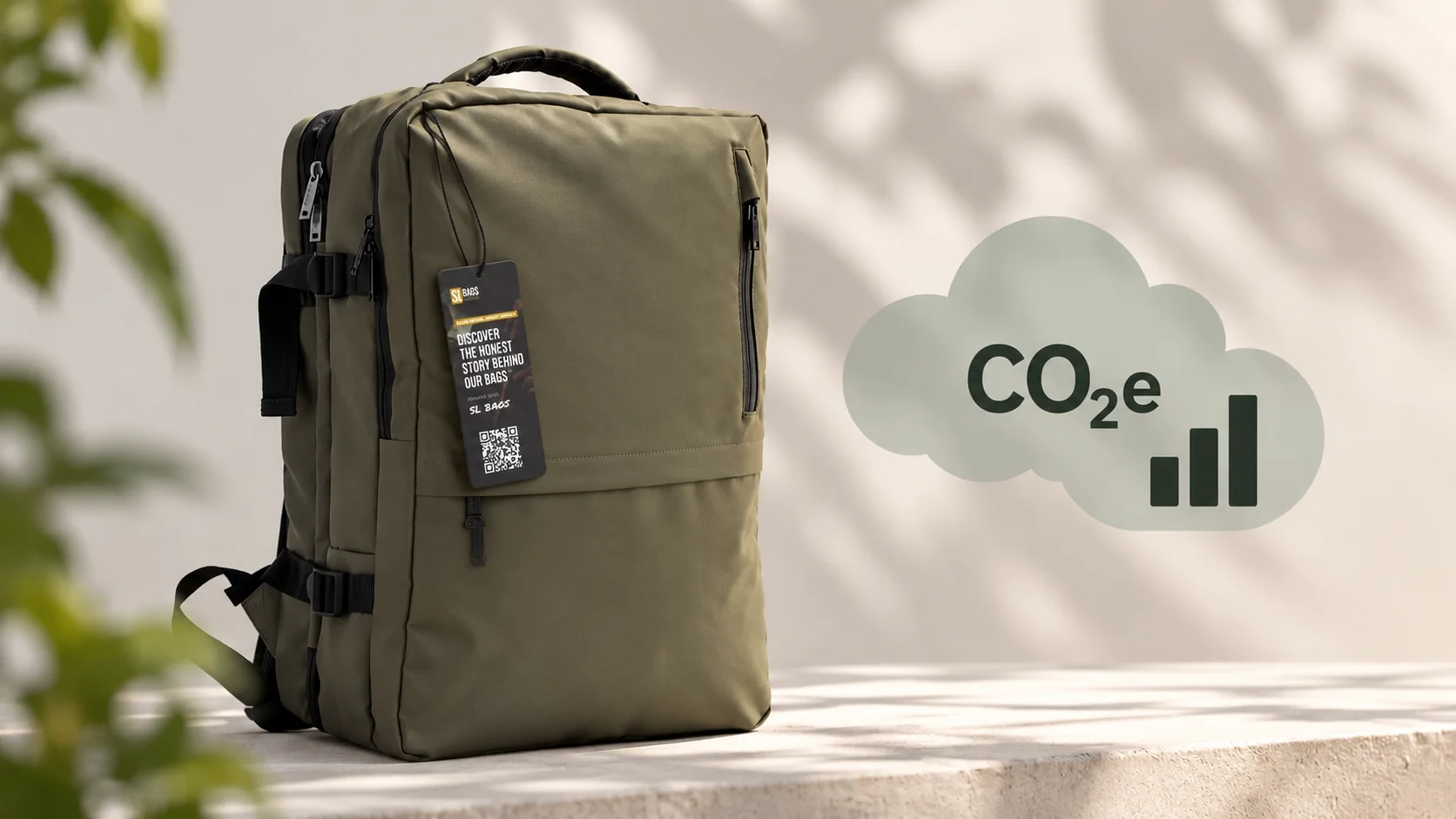
How much CO₂ is emitted in the production of a bag? What impact do the materials used, production processes and transport have? And where are the opportunities to reduce its climate impact? At SL BAGS, we believe it's important to answer these questions with concrete data. That's why we calculate the product carbon footprint of our bags using the IPPAG Carbon Tracking Tool. This helps us make the climate impact of our products more transparent and use these insights to support informed decisions. Because if you want to improve, you first need to know where you stand.
CO₂ Footprint
Measure to understand. Insights to improve.
Sustainability
CO₂ Footprint
What is a Product Carbon Footprint?
The Product Carbon Footprint (PCF) provides insight into the amount of greenhouse gas emissions attributed to a product throughout the different stages of its life cycle. These emissions are expressed in carbon dioxide equivalents (CO₂e).
For a bag, this includes the impact of raw materials, material production, bag manufacturing, packaging and transport. Depending on the scope of the calculation, the use phase and end-of-life processing may also be included.
By bringing this data together, we gain a clearer understanding of a product's climate impact and the factors that contribute to it.
Calculating CO₂ impact with IPPAG.
Since 1 January 2026, SL BAGS has been an official partner of IPPAG (International Partnership for Premiums & Gifts), an international network of companies in the promotional products and merchandise industry.
To calculate the Product Carbon Footprint, we use the IPPAG Carbon Tracking Tool. This tool has been specifically developed for our industry and enables product data to be processed in a structured way.
The tool's calculation methodology has been certified by Bureau Veritas in accordance with the principles of ISO 14067:2018, the international standard for calculating the carbon footprint of products.
This provides us with a methodology for assessing the climate impact of our products in a consistent and evidence-based way.
Which factors do we take into account?
When calculating the Product Carbon Footprint, we consider various stages of the product life cycle.
Materials and raw materials
Which materials are used, in what quantities and what emissions are associated with their production?
Production processes
Where is the bag manufactured and which production processes are required to turn the materials into a finished product?
Transport and logistics
What distances are covered and which modes of transport are used to move materials and products?
Packaging
Which packaging materials are used and what is their associated climate impact?
End of life
Where relevant, we also take into account how the product is processed when it is no longer used, for example through recycling or waste disposal.
Based on the available data and the calculation methodology applied, the carbon footprint of each product is determined.
From insight to targeted improvements.
Calculating the carbon footprint is not an end in itself for us. The real value lies in what we can do with that information.
By gaining a better understanding of which aspects of a product contribute to its climate impact, we can identify opportunities for more targeted improvements.
This includes exploring alternative materials, critically reviewing production processes, optimising packaging and making conscious transport choices.
Not every change automatically results in a lower carbon footprint. That's why we believe it's important to evaluate decisions based on data wherever possible.
This way, measuring helps us not only pursue improvements, but also support them with reliable evidence.
Insights for distributors and their customers.
Information about the climate impact of products is becoming increasingly important for our B2B customers too.
Distributors are receiving more questions about the origins, composition and CO₂ emissions of products they offer as promotional items or corporate gifts.
With our Product Carbon Footprint calculations, we can provide them with concrete information to support customer advice and help substantiate product choices.
We also believe it's important to put CO₂ data into the right context. A lower calculated footprint does not automatically mean that a product performs better across all aspects of sustainability. Factors such as quality, functionality, material use and product lifespan remain important too.
CO₂ information accessible through Trace Me!
The calculated carbon footprint is also part of Trace Me!, our Digital Product Passport for bags from the new VASAD and Recycle Bags collections.
By scanning a QR code on the bag, distributors and end users can access relevant product information, including its calculated CO₂ impact.
This makes the results of our calculations accessible to the people who purchase, recommend and use our products.
Keep measuring. Keep improving.
By making our Product Carbon Footprint more transparent, we take another step in The Honest Journey, our ongoing journey towards greater transparency and more responsible business practices.
We know that measuring climate impact doesn't reduce emissions in itself. But it does provide us with the information we need to take a more targeted approach to evaluating our products and processes.
By working with our production partners and using reliable calculation methods, we aim to make increasingly well-informed decisions and continue exploring opportunities to reduce our impact.
Because understanding is the first step towards improvement.